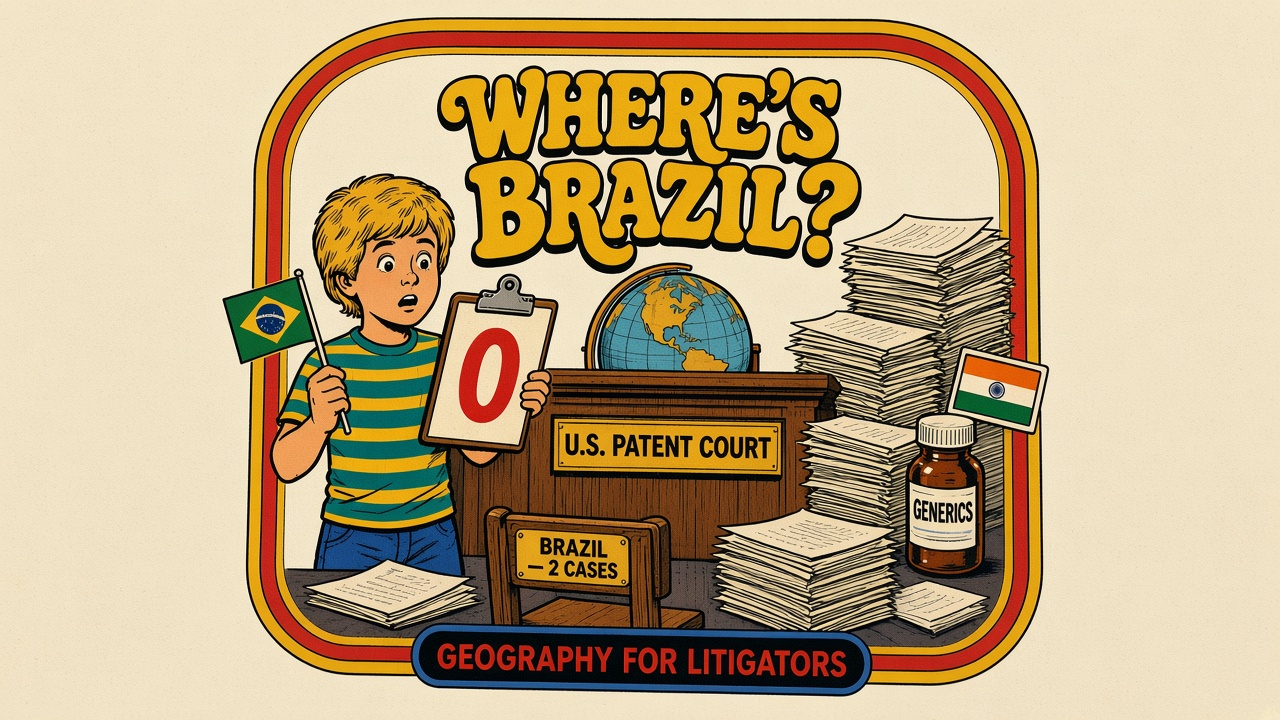
This series has spent a lot of time on who fights patent wars in the United States, the busiest judge, the serial trolls, the drugmakers, the most-sued tech giants. This post is about an absence. Run the same 74,301 cases looking for one of the world's ten largest economies, and it is almost not there at all. Brazil appears in exactly two of them.
Both are worth naming, because together they are the entire Brazilian footprint in U.S. patent litigation. In 2017, the steelmaker Gerdau was named as a defendant in an infringement suit in Indiana; the case closed within three months. Also in 2017, Embraer's U.S. executive-jet services arm was sued by Kaldren LLC, a shell entity that fired off 36 unrelated suits that year, from Snap to JPMorgan, and that case closed within five. The database records only that both cases closed quickly; it does not record who won, and a fast close is as consistent with a settlement as with anything else. That is the whole record: two cases, both as a defendant, both over within months, and not a single instance of a Brazilian company going to a U.S. court to enforce a patent of its own.
The tempting explanation is that this is a rich-country technology war, and Brazil simply is not a chip-and-software economy. But that explanation falls apart on contact with the data. The database is not remotely tech-only, pharmaceutical and medical cases alone run into the tens of thousands, and, more to the point, the single most present foreign country in the entire dataset is not Japan or Germany. It is India, a developing economy with a lower GDP per capita than Brazil, appearing in 1,974 cases, more than Japan (1,751) or South Korea (1,594).
India is everywhere for one reason: generic drugs. Companies like Lupin, Aurobindo, Sun Pharma, Zydus, Cipla and Dr. Reddy's built an export industry aimed squarely at the American pharmacy, and under U.S. law the act of filing to sell a generic is itself an act of patent infringement that triggers a lawsuit. We covered that machinery in an earlier post. The result is that a developing country ends up as one of the busiest participants in U.S. patent court, not despite being a developing economy, but because it chose to compete, at scale, in a specific American market. Israel tells the same story through a single company, Teva, appearing in 561 cases.
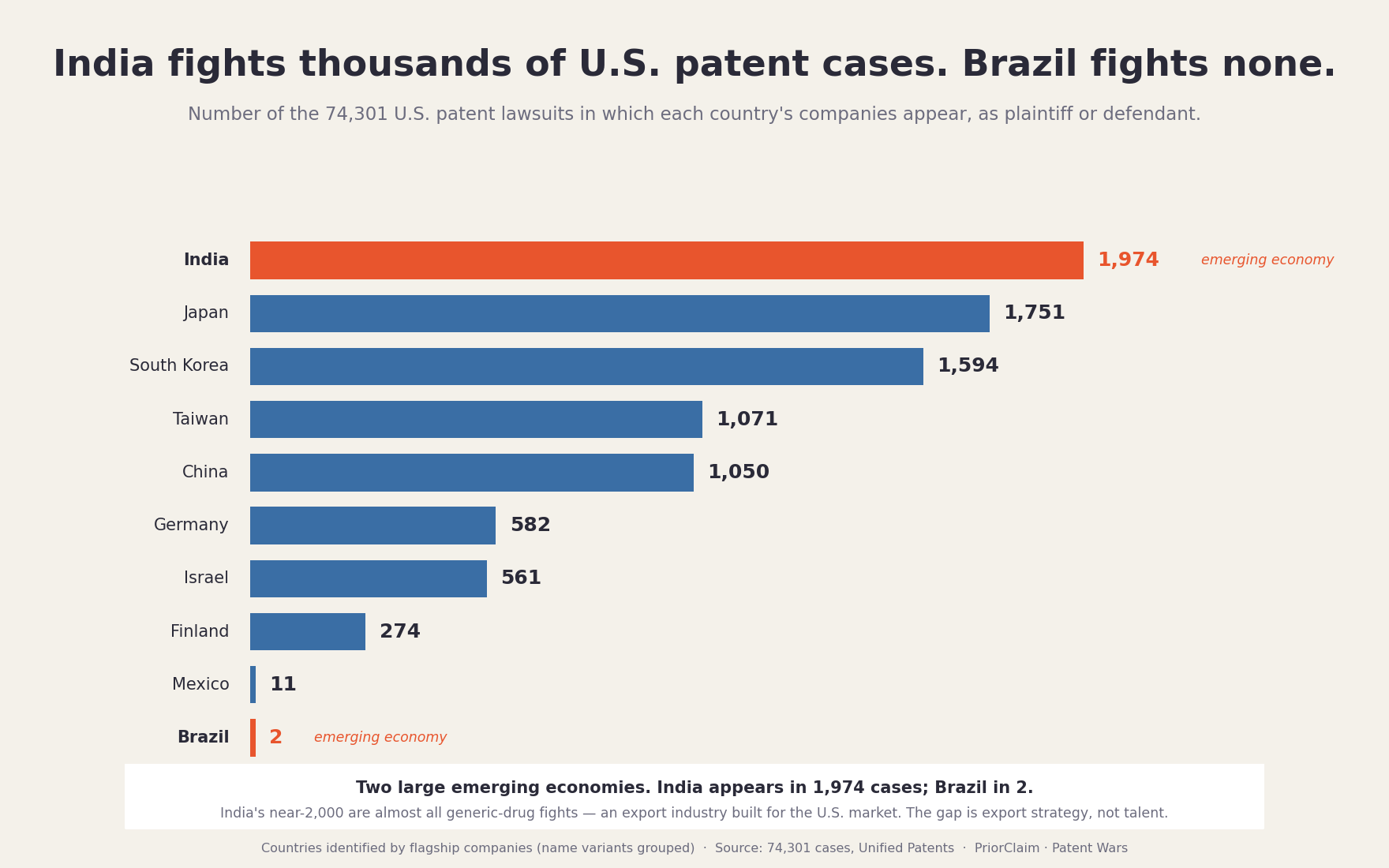
So the real question is not "why isn't Brazil in tech." It is "why does one emerging economy's industry litigate by the thousand in America while another's does not appear at all, in any sector." And the answer is structural. There are only two ways to end up in U.S. patent court: sell products into the American market that can be accused of infringing someone's patent, or own U.S. patents you go to court to enforce. India's generic makers do the first constantly. Brazil's export champions do neither. The country's largest exporters sell iron ore, soybeans, crude oil, beef and, in Embraer's case, aircraft to airlines rather than gadgets to consumers, goods that mostly do not collide with the dense thicket of U.S. consumer and software patents. And Brazilian firms rarely hold and assert U.S. patents, which is the other way in.
It is important to be precise about what this measures, and what it does not. Appearing in U.S. patent litigation is a proxy for presence in the American market and participation in the American patent system. It is not a measure of inventiveness. Brazil produces genuinely advanced engineering, Embraer builds some of the best regional jets in the world, and the absence of Brazilian names from these dockets is not evidence that the country cannot innovate. It is evidence of where Brazilian companies choose to compete, and in what form. The patent war is a map of the U.S. economy's contested edges, and Brazil's economy mostly touches America somewhere else.
Whether that absence is good news or bad is genuinely open. On one reading, Brazil has been spared a tax the participants pay dearly: the trolls, the nuisance settlements, the seven-figure defense bills that fill the rest of this series. On another, showing up in U.S. patent court is a side effect of selling high-value, patent-dense products into the world's largest market, and never showing up may say something about how much of that Brazil does. The two cases in the record are both Brazilian companies being sued, and both over within months. Nobody from Brazil has yet shown up on the other side of the "v.," patent in hand, to make a claim of their own.
Method: countries are identified by their flagship companies (name variants grouped), counting the distinct U.S. cases in the Unified Patents litigation database (74,301 infringement cases) in which any of those companies appears as plaintiff or defendant. This undercounts every country to some degree, smaller firms and subsidiaries under unfamiliar names are missed, so the figures are lower bounds, not censuses. That caveat cuts against the argument, not for it: even generously, Brazil's presence rounds to nothing. India's total is dominated by generic-pharmaceutical defendants. Counts describe filings, not outcomes.
Sources: Unified Patents litigation database (portal.unifiedpatents.com); Amerifab Inc. v. Gerdau Ameristeel US Inc. et al., S.D. Ind. (2017); Kaldren LLC v. Embraer Executive Jet Services LLC, D. Del. (2017); PriorClaim Patent Wars, "Big Pharma's other war: the lawsuits that keep your generic off the shelf."