Earlier in this series we looked at the entities that only ever appear on one side of the "v." — the serial plaintiffs who sue constantly and are almost never sued back. This is the mirror image. There is a group of companies that only ever appear on the other side: sued relentlessly, suing almost no one.
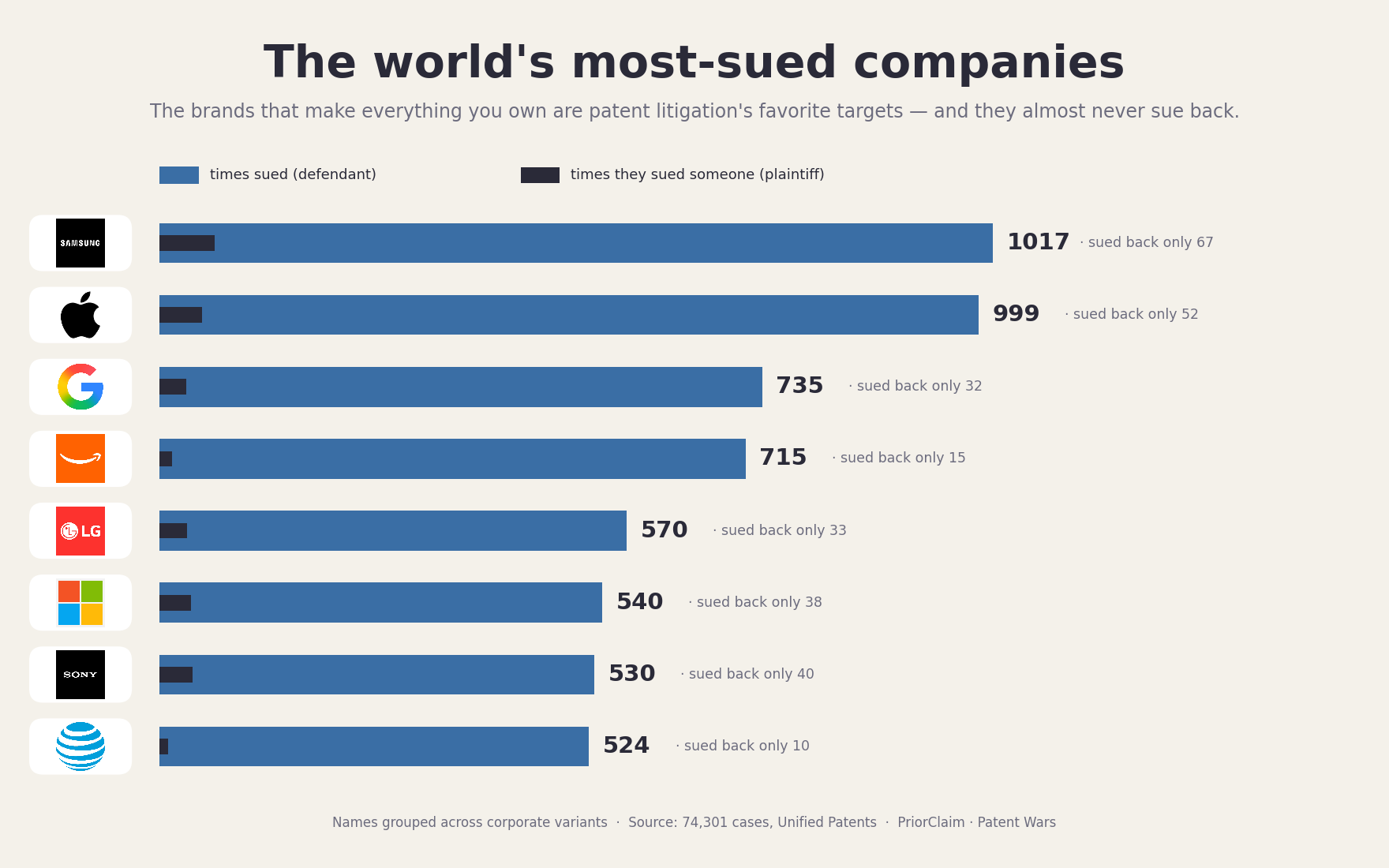
They are the most recognizable brands on earth. In the Unified Patents dataset, Samsung has been named as a defendant 1,017 times and Apple 999 — each roughly a thousand patent lawsuits. Google follows at 735, Amazon at 715, then LG, Microsoft, Sony and AT&T, all above 520. And the asymmetry is stark. Apple filed just 52 suits of its own against those 999. Amazon: 15 against 715. AT&T: 10 against 524. The companies that make everything you own are, in patent terms, almost pure prey.
The reason is the same mechanism that powers the troll, only turned inside out. A non-practicing entity makes nothing, so there is nothing to sue it over — that is its shield. A company like Apple or Samsung is the exact opposite: it ships hundreds of millions of complex products, each one combining thousands of patented components. Every product is a surface. Anyone holding a patent that arguably reads on any part of a phone, a cloud service or a chip has a plausible target — and a wealthy one. Making real things does not protect you. It paints the target on your back.
Who does the suing? At least a quarter of the cases against each of these giants were filed by the serial plaintiffs from our earlier analysis — the entities that sue in volume and are essentially never sued in return. For Amazon and Google, that narrow group alone accounts for about 30% of everything filed against them, and it is a floor, not a ceiling: it counts only the most prolific operators, not the thousands of one-shot shells. Deep pockets do not just attract lawsuits. They attract the business model built around lawsuits.
There is a geographic echo here too. A large share of these cases were filed in the same small set of plaintiff-friendly courts we mapped in the first post — the Eastern District of Texas above all. The machine that concentrated a quarter of America's patent docket in one Texas courtroom was, to a significant degree, pointed at exactly these companies. The most-sued brands and the most-used venue are two views of the same system.
So when do these giants actually sue? Mostly, it turns out, each other. The rare cases where Apple, Samsung, Microsoft or Sony appear as plaintiffs are often aimed at a direct rival — the smartphone design-patent wars of the 2010s, in which Apple and Samsung spent years litigating across multiple countries, are the famous example. Two manufacturers with real products, arguing over real technology. But even at its most dramatic, that fighting is a rounding error next to how often each of them is dragged into court by someone with no product at all.
That is the quiet lesson buried in the numbers. Across this whole series the same asymmetry keeps surfacing, and here it reaches its cleanest form. Build nothing, and you can sue anyone while being untouchable yourself. Build the products the modern world runs on, and you become the most-sued entity in the country — taxed, case by case, for the crime of having made something worth suing over.
Method: figures count parties in the Unified Patents litigation database (74,301 infringement cases), aggregating known corporate name variants for each company (e.g. Samsung's several U.S. entities are combined). "Sued back" counts appearances as a plaintiff. "Serial plaintiffs" are defined as in our earlier post — parties filing 20 or more suits while appearing as a defendant two times or fewer. Counts describe filings, not outcomes.
Sources: Unified Patents litigation database (portal.unifiedpatents.com); PriorClaim Patent Wars, "The 636 entities that sue — and are never sued back" and "One judge, one small Texas town."