Run the numbers on who files patent lawsuits and a surprising kind of plaintiff surfaces: the university.
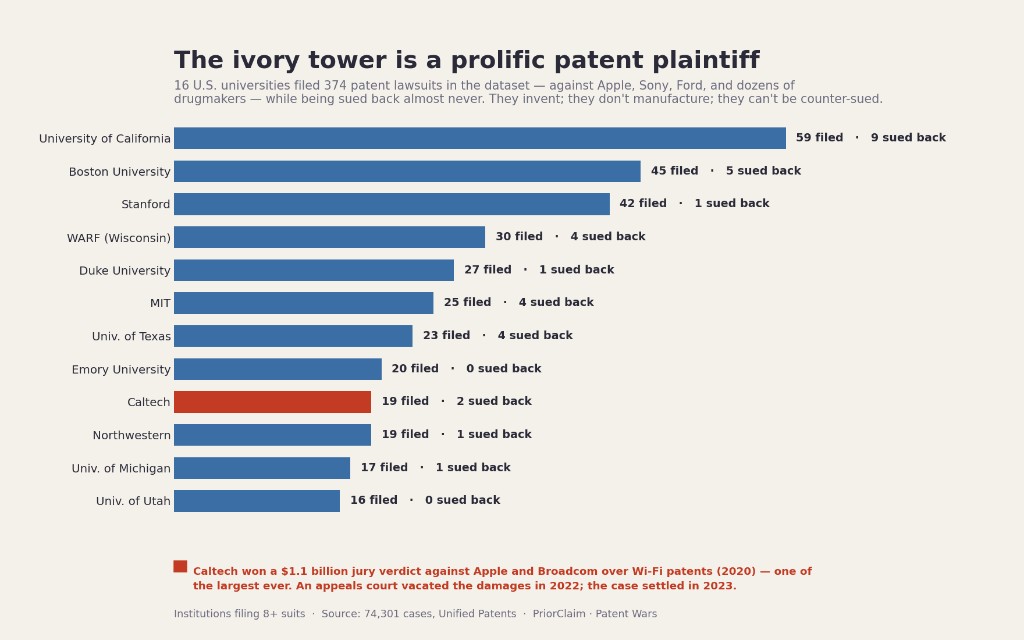
In the Unified Patents dataset, sixteen U.S. universities and research foundations filed at least eight patent suits each — 374 in total — while landing on the receiving end almost never. The University of California filed 59. Boston University, 45. Stanford, 42. The Wisconsin Alumni Research Foundation, 30. MIT, Duke, Emory, Northwestern, the University of Texas, Michigan, Utah, Caltech — all appear as repeat litigants, and several were never sued back a single time.
By the raw statistics, that profile looks a lot like the one we examined last time: entities that sue constantly and are almost never sued in return. And the mechanism is the same. A university makes nothing you can buy off a shelf, so there is no product to counter-sue over. It owns patents; it enforces them.
But this is the one flavor of non-practicing entity that most people are willing to defend — because the university actually invented the thing. The patents come out of real labs and real research, funded in no small part by the public. When Stanford or MIT sues, it is asserting work it genuinely did. That is a very different claim from a shell company that bought a vague patent to mail out demand letters.
The targets are more varied than you would guess. Some are exactly who you would expect from a research university: WARF has sued Apple; MIT has gone after Ford, Toshiba and Micron; Boston University pursued Sony and a string of display manufacturers. But a large share of university litigation points somewhere else entirely — at generic-drug makers. The University of California, Emory and Northwestern have repeatedly sued companies like Aurobindo, Mylan, Sandoz and Lupin. Universities, it turns out, are quiet but serious players in the pharmaceutical patent wars, defending the drug discoveries they license to industry.
And then there is the headline number. In 2020, a Los Angeles jury awarded the California Institute of Technology $1.1 billion — one of the largest patent verdicts in U.S. history — after finding that Wi-Fi chips in hundreds of millions of iPhones infringed Caltech patents. It is the kind of figure that rewrites the image of the university as a gentle place of inquiry.
It also comes with a lesson about how fragile even the biggest wins are. In 2022, a federal appeals court threw out the $1.1 billion award as "legally unsupportable" and ordered a new trial on damages, while leaving parts of the infringement finding intact. The case ultimately settled in 2023, on terms that were never disclosed. The record-breaking headline and the quiet settlement are the same case — a reminder that a jury number and a final outcome are two very different things.
The larger point is not that universities are villains. It is that the same structural asymmetry that powers the patent-troll business — sue often, get sued never — also describes the most respectable institutions in the country. The difference is not the mechanism. It is whether you built the idea you are enforcing.
Method: figures count parties in the Unified Patents litigation database (74,301 infringement cases), aggregating known corporate and campus name variants for each institution; includes institutions filing eight or more suits. Counts describe filings, not outcomes — no ruling or settlement is inferred except where explicitly cited and sourced.
Sources: Unified Patents litigation database (portal.unifiedpatents.com); California Institute of Technology v. Broadcom Ltd. and Apple Inc., C.D. Cal. jury verdict (Jan. 2020) and Fed. Cir. decision vacating damages (Feb. 2022); news coverage of the 2023 settlement (CNBC, Reuters).