There is a category of litigant in American patent law that only ever appears on one side of the "v."
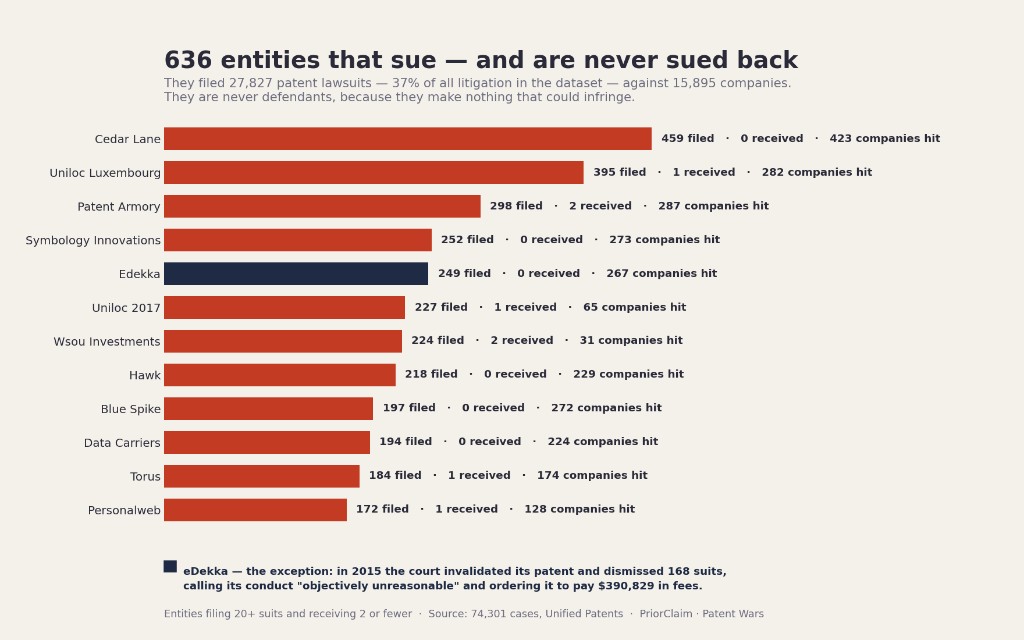
Across 74,301 U.S. patent infringement cases, 636 entities filed at least 20 lawsuits each while being sued two times or fewer in return. Most were never sued at all. Together they brought 27,827 cases — 37% of all litigation in the dataset — against 15,895 different companies.
That asymmetry is not luck. It is the business model. A company that manufactures something can be counter-sued: it ships products, and products can infringe someone else's patent. An entity that manufactures nothing has no exposure. It owns patents and files lawsuits, and there is nothing to aim back at. In the trade they are called non-practicing entities, or NPEs. In plainer language, patent trolls.
The scale of the individual operators is easy to underestimate. Cedar Lane filed 459 suits against 423 companies and has never been sued once — and it is still active. Symbology Innovations: 252 suits, 273 companies, zero received. Blue Spike: 197 and zero. Uniloc, split across several corporate shells, accounts for more than 600 filings between them.
Look at the dates and a second pattern appears: many of these entities have short, intense lives. Data Carriers filed 194 suits in four years and vanished. eDekka filed 249 in three. TQP Development reached 301 companies in seven years, then stopped. These are not businesses in any ordinary sense. They are campaigns.
The economics explain the speed. Defending a patent case in the United States routinely costs seven figures. If a settlement can be had for a fraction of that, paying is the rational choice, regardless of whether the patent is any good. Volume does the rest: file enough cases, settle most of them quickly, and the arithmetic works even if you would lose every fight you actually had.
One case shows what it looks like when the arithmetic fails. In 2015, eDekka — 249 suits, zero received — was brought up short in the Eastern District of Texas by Judge Rodney Gilstrap. The court invalidated the patent it was asserting, dismissed 168 pending suits at once, and found the case "exceptional," describing eDekka's position as "objectively unreasonable" and its tactic as exploiting the high cost of defense to extract nuisance-value settlements. It was ordered to pay $390,829 in fees to more than twenty defendants.
The venue detail is worth pausing on. The Eastern District of Texas is the same court that, in these same years, drew a larger share of the nation's patent docket than anywhere else — the venue that made this kind of campaign practical in the first place. The place that became the machine's favorite address is also where one of its operators was finally handed a bill.
That remains the exception. The 636 are not a handful of famous villains; they are a structural feature of the system, responsible for more than a third of everything filed. Reform has bent the curve at moments. It has not changed the underlying asymmetry: if you build nothing, no one can sue you back.
Method: figures count parties in the Unified Patents litigation database (74,301 infringement cases). "Entities that only sue" are defined here as parties filing 20 or more suits while appearing as defendant two times or fewer; corporate name variants are grouped where the brand is identifiable, so some related shells are counted separately. Counts describe filings, not outcomes — no ruling or settlement is inferred except where explicitly cited.
Sources: Unified Patents litigation database (portal.unifiedpatents.com); eDekka LLC v. 3Balls.com Inc., E.D. Tex. (2015), order finding case exceptional and awarding fees.