Every time you order something online — anywhere in the world — you expect the same small miracle: a status update. Shipped. Out for delivery. Arrived. It feels like infrastructure, like something the internet simply does. In American patent court, it was also a business model.
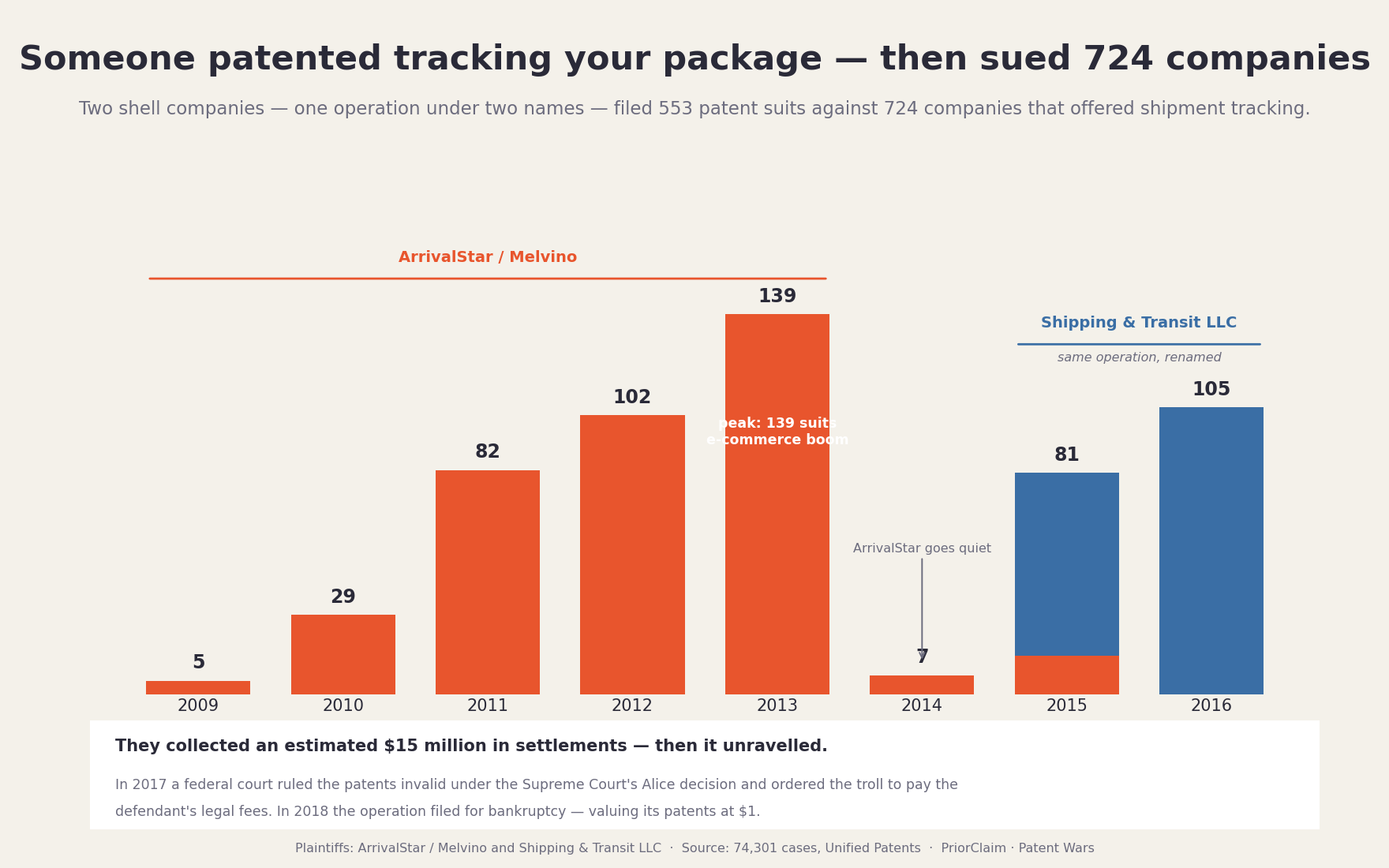
In the Unified Patents dataset, two related plaintiffs built an entire litigation campaign around a single claim: that they owned the idea of tracking a shipment and telling the customer where it is. ArrivalStar, with its partner Melvino Technologies, filed 381 suits. A successor called Shipping & Transit LLC filed another 172. Together that is 553 lawsuits against 724 different defendants — and across all of them, these entities were named as a defendant just six times. They sued constantly and were essentially never sued back.
The timeline reads like a gold rush. Filings were sparse in the early years, then accelerated as e-commerce scaled: 29 suits in 2010, 82 in 2011, 102 in 2012, peaking at 139 in 2013 — the year online shopping stopped being a niche and became the default. The suits did not track innovation. They tracked a consumer expectation that had just gone global.
This is what makes the episode legible far outside the United States. You do not need to know what the Eastern District of Texas is, or who a particular judge is. You have ordered something. You have refreshed a tracking page. The lawsuit is about that refresh — the act of being told your package exists, is moving, and might arrive. It is one of the purest examples in the dataset of patent litigation detached from engineering and attached to ordinary digital life.
The patents behind it were originally framed around notifying people when a vehicle — a bus, a delivery truck — was about to arrive. Stretched far enough, that language could be aimed at almost any "track your order" feature, and it was. The defendants read like a map of the shipping ecosystem's long tail: Hapag-Lloyd, Aramex, Global Satellite Engineering, Gulf Express International, small fleet-tracking firms, retailers with delivery alerts, and at one point Lyft. Not household names in every case — the plumbing behind the tracking dot. A patent that covers "informing a customer about a shipment's status" is a patent that covers almost anyone who touches logistics software. That breadth was not a bug in the strategy. It was the strategy.
The economics were the whole point. Defending a patent suit in the United States routinely costs seven figures; the settlements here ran from a few thousand to a few tens of thousands of dollars. For a logistics startup, paying to make the problem vanish was the rational move, whatever the patent was actually worth. These cases were never built to reach a jury and explain GPS to a judge — the tracking-troll suits in the data closed in a median of about 77 days, roughly a third of the 219-day median for patent cases overall. They were built to land as a line item on a CFO's desk: settle, or spend six figures proving the obvious. Reporting by the Electronic Frontier Foundation estimated the operation collected more than $15 million this way.
The two names are the tell. ArrivalStar's filings collapse to 7 in 2014 — and then Shipping & Transit LLC picks the campaign right back up, filing 67 suits in 2015 and 105 in 2016. Same patents, same tactic, new letterhead. For a while it kept working: in 2016, Shipping & Transit was one of the most prolific patent plaintiffs in the entire country.
What finally stopped it was a change in the law, and defendants willing to use it. In 2014 the Supreme Court, in Alice Corp. v. CLS Bank, ruled that taking an abstract idea and adding "do it on a computer" is not enough to earn a patent. That gave targets a real weapon. In 2017 a federal court threw out Shipping & Transit's patents as invalid under Alice, called the company's own arguments "objectively unreasonable," found a pattern of "exploitative litigation," and ordered it to pay a defendant's legal fees — the one outcome the whole model is built to avoid. In 2018 the operation filed for bankruptcy. In that filing, the patents it had used to extract millions were valued at one dollar.
The lesson travels, even though the law does not. A U.S. case is a U.S. case — but the behavior it rewards is universal: find a feature everyone already uses, claim it, and tax the companies that built it because customers demanded it. For most of a decade, the world's most boring feature — the tracking dot — was treated as someone's private property, and it took a Supreme Court decision and a stubborn defendant to prove it never was. The package on your doorstep is not the product of a patent fight. The tracking page almost certainly passed through one.
Method: figures count filings in the Unified Patents litigation database (74,301 infringement cases) where the plaintiff is ArrivalStar / Melvino or Shipping & Transit LLC, including variant spellings and co-plaintiff listings (553 suits). Defendant count aggregates distinct defendant name strings in those cases (724 unique strings; corporate variants are not merged). Yearly counts use filing date; three older filings (2002–2007) fall outside the charted 2009–2016 window. Case-duration medians use filing-to-termination dates. Counts describe filings, not outcomes; the $15 million figure and the bankruptcy valuation come from cited reporting and court records, not from this dataset.
Sources: Unified Patents litigation database (portal.unifiedpatents.com); Alice Corp. v. CLS Bank International, 573 U.S. 208 (2014); Shipping & Transit, LLC v. Hall Enterprises, Inc., C.D. Cal. (2017), order finding the case exceptional and awarding fees; Electronic Frontier Foundation reporting on ArrivalStar / Shipping & Transit (2016–2018); PriorClaim Patent Wars, "The 636 entities that sue — and are never sued back."