Marshall, Texas had 23,392 residents at the 2020 census. For more than a decade, it has also been one of the most important places on earth to file a patent lawsuit.
Across 74,301 U.S. patent infringement cases in the Unified Patents litigation database, one name appears more than any other: Judge Rodney Gilstrap, of the Eastern District of Texas. He has presided over roughly 9,200 of them — about 1 in 8 of every case in the dataset. No other judge is close. The next-busiest handled about a third as many.
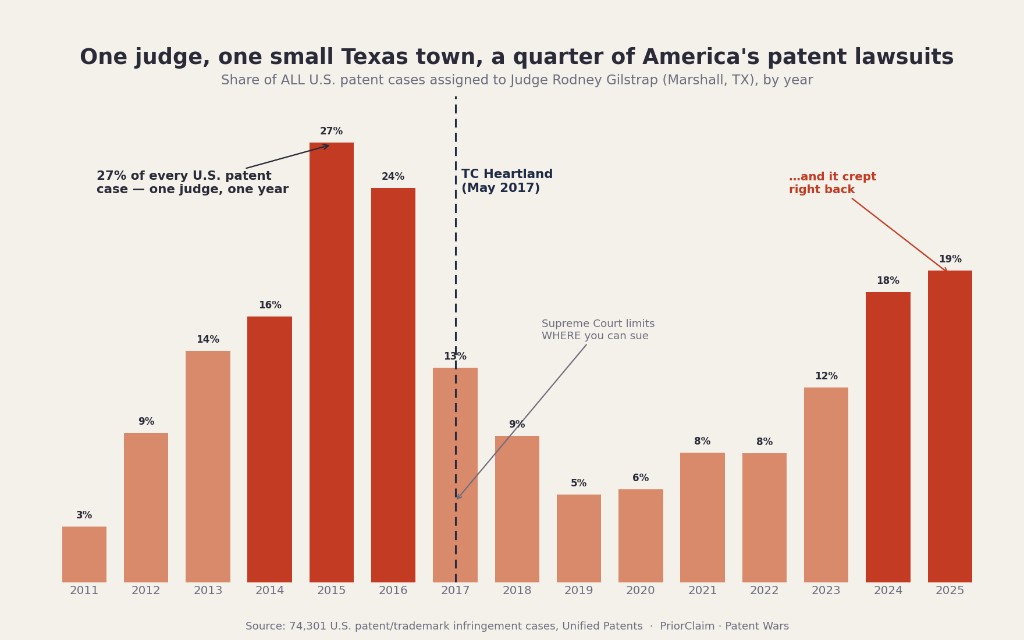
At the peak, the concentration was staggering. In 2015, cases assigned to Gilstrap alone accounted for 27% of all patent litigation filed that year. One judge. One year. More than a quarter of the national docket.
This is what forum shopping looks like in numbers. Plaintiffs — and especially patent-assertion entities, the so-called trolls — favored the Eastern District of Texas for its fast dockets and plaintiff-friendly local rules. Two districts, East Texas and Delaware, together absorbed 37.5% of all litigation in the dataset. The map of American patent justice was never a map of America. It was a handful of courthouses.
Then the Supreme Court intervened. On May 22, 2017, in TC Heartland LLC v. Kraft Foods Group Brands LLC, a unanimous Court reinterpreted the patent venue statute: for purposes of venue, a domestic corporation "resides" only in the state where it is incorporated — not wherever a plaintiff chose to sue.
You can watch the ruling land in the data. Gilstrap's share of the national docket fell from 27% in 2015, to 13% in 2017, to 5% by 2019. The reform worked.
And then the numbers climbed back. From that 5% floor: 12% in 2023, 18% in 2024, 19% in 2025. The single most concentrated courtroom in American patent law is once again hearing close to one in five cases nationwide.
Why it rebounded is the open question. The data shows the pattern clearly but cannot explain it on its own — plausible factors include shifts in how cases are distributed within other districts, changes in filing strategy, and broader trends in overall filing volume. What the record does establish is that the concentration proved durable: a landmark Supreme Court ruling bent the curve for about five years, and then the curve bent back.
The lesson isn't really about one judge. It is that where a case is heard is not a neutral procedural detail. It shapes cost, speed, and leverage — and for two decades that choice has clustered in a very small number of courtrooms. The geography of patent justice has a center of mass, and it has been remarkably hard to move.
Method: figures are counts of case assignments in the Unified Patents litigation database (74,301 infringement cases; 95% list a presiding judge). "Gilstrap" includes cases where he is listed among the presiding judges. Percentages are shares within this dataset, not an independently verified census of all U.S. patent filings. All figures describe filings, not outcomes — no ruling, settlement or verdict is inferred.
Sources: Unified Patents litigation database (portal.unifiedpatents.com); TC Heartland LLC v. Kraft Foods Group Brands LLC, 581 U.S. 258 (2017); U.S. Census Bureau QuickFacts, Marshall city, Texas.