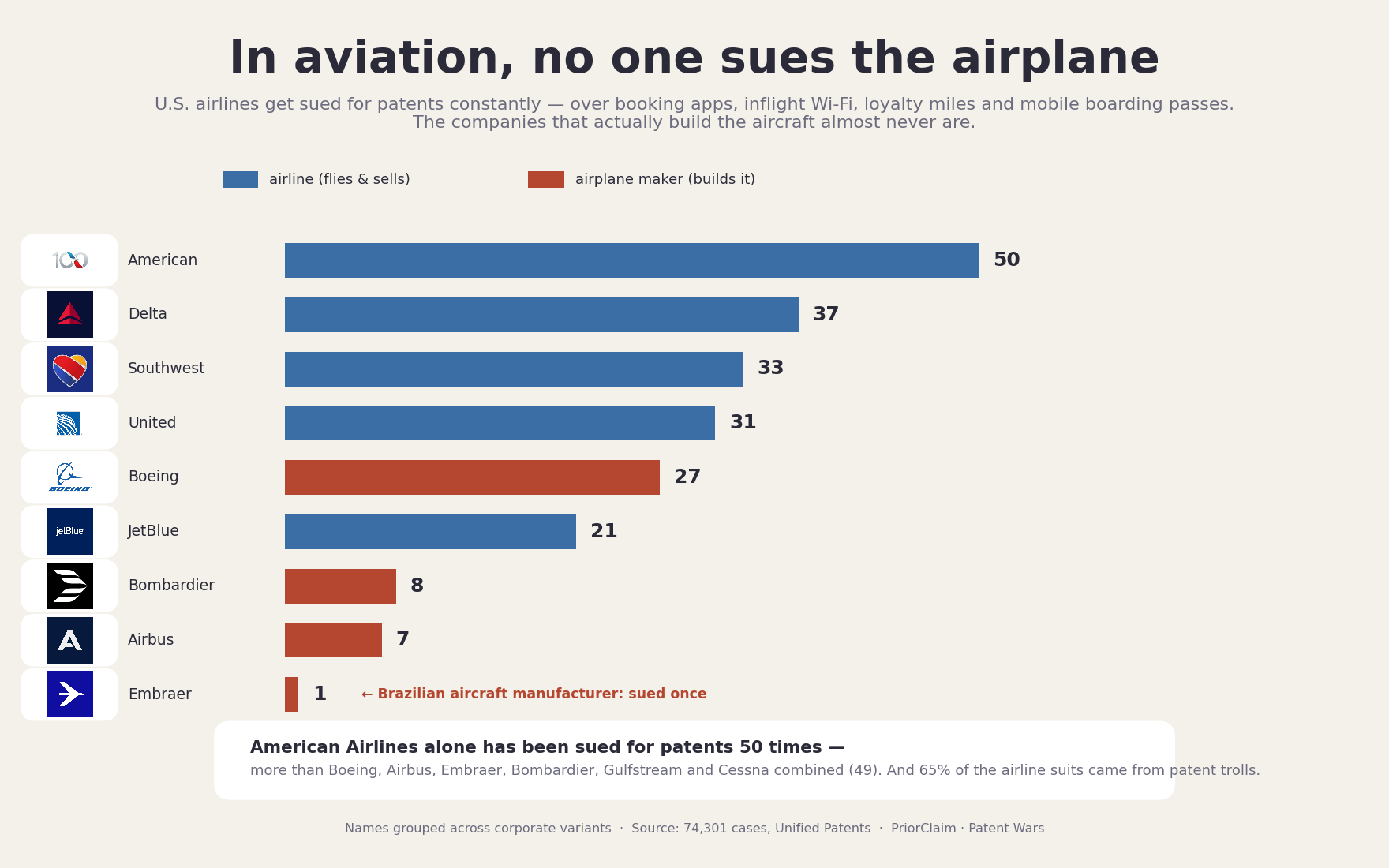
You would expect the patent fights in aviation to be about aviation — wings, engines, the hard and secretive engineering that goes into a jet. They almost never are. In the Unified Patents dataset, the companies that actually build aircraft barely appear, and the ones dragged into court again and again are the airlines — sued not over how a plane flies, but over how you book it, board it, and connect to the internet at 35,000 feet.
The numbers make the point on their own. American Airlines has been named as a defendant in 50 patent cases. Delta in 37, Southwest 33, United 31, JetBlue 21. Across the major U.S. carriers there are 159 suits in the data. Now compare the other side of the industry — the people who design and manufacture the aircraft. Boeing: 27. Airbus: 7. Bombardier: 8. Gulfstream: 5. Embraer, the Brazilian aircraft manufacturer: exactly one. Add up every major airframe manufacturer and you reach 49 — fewer than American Airlines has faced by itself.
What are the airlines being sued over? Their software. The plaintiffs' names read like a map of the digital layer wrapped around modern flying: Loyalty Conversion Systems, Unified Messaging Solutions, Aeritas, MacroSolve — entities whose patents cover things like loyalty and rewards programs, digital messaging, and mobile boarding on a phone. This is not litigation about aerodynamics. It is litigation about the booking site, the app, the frequent-flyer account and the inflight Wi-Fi portal.
And it comes overwhelmingly from one type of plaintiff. About 65% of the suits against the airlines were filed by the serial, non-practicing entities we mapped earlier in this series — the ones that make nothing and sue in volume. This is the patent-troll business model, wearing an airline uniform. A carrier is a near-perfect target for it: it is enormous, it is rich, and it runs exactly the kind of consumer software — apps, websites, payment and messaging systems — over which broad, arguable patents are easy to assert.
The contrast with the airframe is the whole story. A modern airliner is arguably the most sophisticated machine that gets mass-produced, and yet in this dataset it is almost untouchable in patent court. Part of that is structural: a jet is a deeply integrated, heavily certified product built by a handful of firms with enormous patent portfolios of their own, and it is a hard, specific thing to claim you invented a piece of. A mobile boarding pass is not. The moment aviation turns into ordinary consumer software — the part of the experience that looks like every other app on your phone — it enters the same open field where the trolls already live.
That is why Embraer showing up a single time is not a fluke, and it is quietly revealing. The physical airplane, the part Brazil actually builds and exports, sits almost entirely outside this war. The war is over the thin digital skin the airlines put on top of flying — and that skin is the same everywhere, which is exactly what makes it so easy to sue over.
The lesson rhymes with everything else in this series. Patent litigation does not chase the hardest engineering; it chases the softest, most widely shared surface with the deepest pockets behind it. In aviation, that surface is not the plane. It is the app that sells you the seat.
Method: figures count parties in the Unified Patents litigation database (74,301 infringement cases), aggregating known corporate name variants for each company. "Airlines" groups the major U.S. passenger carriers; "airframers" groups the principal commercial and business-jet manufacturers. "Serial / non-practicing entities" are defined as in our earlier posts — parties filing 20 or more suits while appearing as a defendant two times or fewer; the 65% figure is a floor, since it counts only the most prolific filers. Counts describe filings, not outcomes, and the characterization of what each suit concerns is inferred from the plaintiffs and is not a ruling on any patent's validity.
Sources: Unified Patents litigation database (portal.unifiedpatents.com); PriorClaim Patent Wars, "The 636 entities that sue — and are never sued back."