The most expensive patent war in America is not about smartphones or chips. It is about the pills in your medicine cabinet — and unlike the others, this one has a direct line to what you pay at the pharmacy.
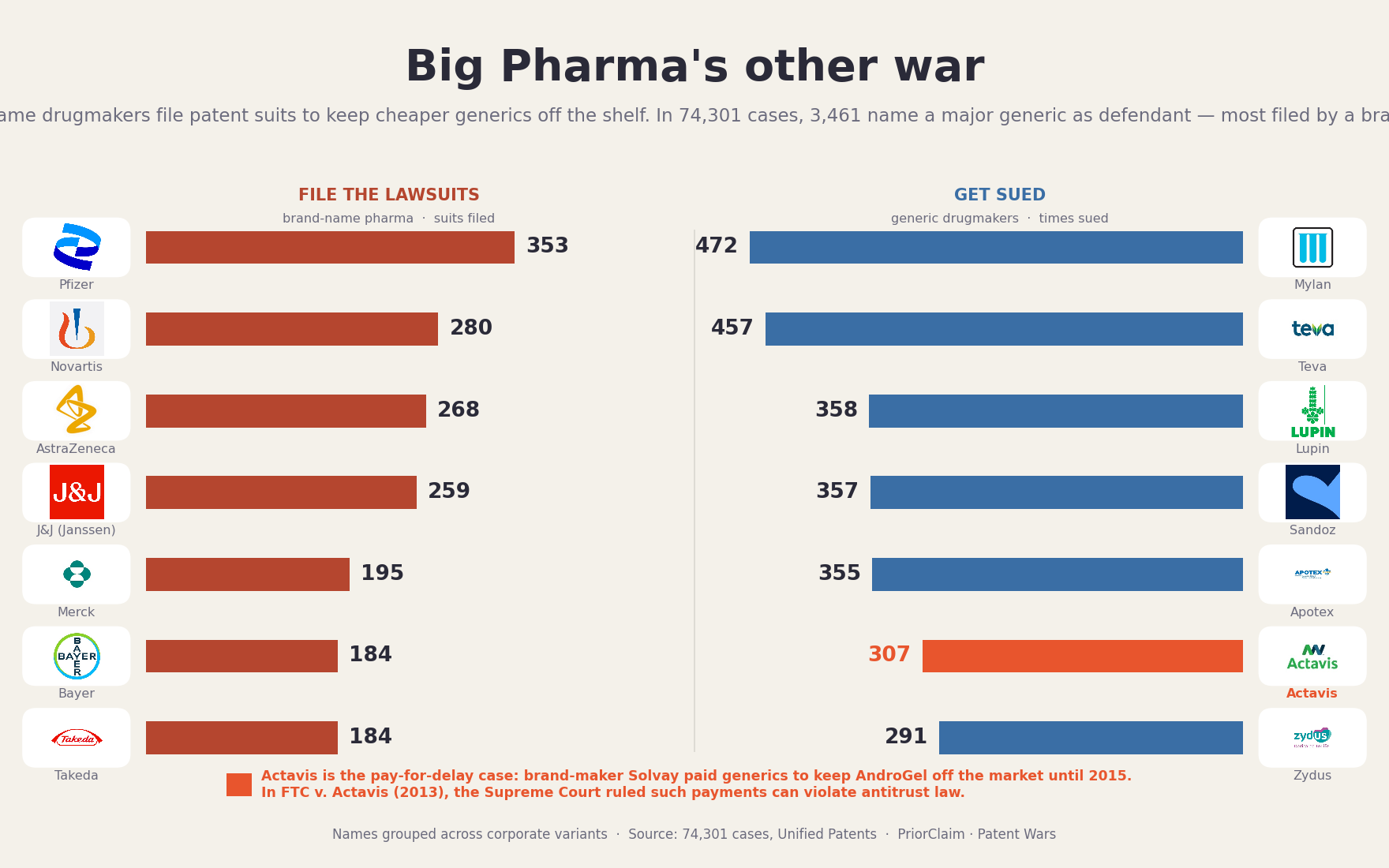
In the Unified Patents dataset, 3,461 of the 74,301 cases name one of the large generic-drug manufacturers as a defendant: Mylan appears 472 times, Teva 457, Lupin 358, Sandoz 357, Apotex 355. On the other side of the "v." are the most recognizable names in medicine — Pfizer filed 353 suits, Novartis 280, AstraZeneca 268, Johnson & Johnson's Janssen 259, Merck 195. Brand-name drugmakers suing the companies whose entire business is making their drugs cheaper.
To see why this happens on an industrial scale, you have to understand a law almost no one outside the industry has heard of. The Hatch-Waxman Act of 1984 created the fast track that lets a generic reach the market without repeating the original clinical trials. But it came with a trade. When a generic company files to sell its version, it must certify that the brand's patents are invalid or not infringed — and that certification is itself defined, by statute, as an act of patent infringement. The brand can then sue, and the mere act of suing triggers an automatic hold of up to 30 months on the generic's approval. Filing to make a cheaper drug does not risk a lawsuit. It guarantees one.
That is why the same names cycle through the courts year after year, and why the volume is so steady: this is not litigation that flares up over a dispute, it is a permanent toll booth built into the approval process. The peak years in the data — around 320 of these cases filed in 2014 and 2015 — track the expiry of a wave of blockbuster drugs, each one worth fighting over molecule by molecule.
Here is the honest part, the part that makes this different from the patent-troll story. The brand companies usually did invent the drug. They ran the trials, absorbed the failures, and spent real money doing it. A patent on a medicine that took a decade and a fortune to develop is exactly the kind of patent the system is supposed to protect. When Novartis sues to defend a molecule it discovered, that is not an abuse — it is the deal society offered in exchange for the invention. So the uncomfortable question is not "should they be allowed to sue," but "what happens when a legitimate right is used to delay a legitimate competitor for as long as possible."
Sometimes the answer crosses a line the courts can name. Look at Actavis on the chart — 307 suits, and the defendant in the case that gave the practice its legal identity. The brand-maker of AndroGel, a testosterone gel, did not just sue the generics that wanted to copy it. It paid them. In a set of settlements, the brand handed the generic companies money in exchange for a promise to keep their cheaper versions off the market until 2015. The generic was paid not to compete. In FTC v. Actavis (2013), the Supreme Court ruled that these "reverse payment" or "pay-for-delay" deals can violate antitrust law — that a patent settlement where the patent-holder pays the challenger is a signal that something other than the patent's merits is being bought.
The most studied example of a related tactic is Humira, AbbVie's arthritis drug and for years the best-selling medicine in the world. AbbVie built what critics call a patent thicket around it: roughly 250 patents, the large majority filed after the drug was already approved, each one a fresh obstacle a competitor would have to clear or challenge. The core patent expired in 2016. Biosimilar competitors reached European patients in 2018. American patients waited until 2023 — the gap held open by litigation and settlements. A congressional analysis put the cost of that delay to U.S. payers at roughly $19 billion. When competition finally arrived, the drug's effective price fell by an estimated 38%.
There is a thread back to an earlier post in this series. Some of these brand patents did not start in a corporate lab at all — they started in a university one. Public research institutions license their discoveries to industry, which is part of why schools like the University of California and Emory show up suing generic-drug makers directly. The molecule can travel from a publicly funded lab, to a brand's patent portfolio, to a courtroom, to the price you pay — and the same enforcement machinery runs the whole length of it.
None of this resolves into a villain. Drug development is genuinely expensive and genuinely risky, and a patent system that let generics copy a breakthrough the day it launched would mean fewer breakthroughs. But the same asymmetry that runs through every chapter of these patent wars is here too, in its most consequential form: the right to exclude is enormously valuable, and the incentive to stretch it — by 30 months, by a thicket of follow-on patents, by paying a rival to wait — is enormous. The brands invented the molecule. The question the record keeps posing is how long, and by what means, they get to be the only ones allowed to sell it.
Method: figures count parties in the Unified Patents litigation database (74,301 infringement cases), aggregating known corporate name variants for each drugmaker; a case is counted here when a major generic manufacturer appears as a defendant. Counts describe filings, not outcomes — no ruling or settlement is inferred except where explicitly cited and sourced. Suit totals per company count appearances as a named party and may include related corporate entities.
Sources: Unified Patents litigation database (portal.unifiedpatents.com); Drug Price Competition and Patent Term Restoration Act of 1984 (Hatch-Waxman), 21 U.S.C. § 355 and 35 U.S.C. § 271(e); FTC v. Actavis, Inc., 570 U.S. 136 (2013); congressional and press analyses of AbbVie's Humira patent portfolio and biosimilar entry (U.S. House Committee on Oversight and Reform report on AbbVie, 2021; BioPharma Dive; Fierce Pharma).